Acoustic Noise of MLCC
Aug 07, 2023
Insects and birds sing, spring water sings and sounds, and the sound originates from the vibration of objects. It is a well-known thing that the human ear can recognize sound waves with a vibration frequency of 20Hz~20kHz. However, multi-layer Chip Ceramic Capacitors (MLCC) sometimes emit an audible sound, a frustrating phenomenon often referred to by hardware engineers as a singing capacitor. So, what exactly causes this ceramic capacitor noise, and why do MLCCs sometimes make an MLCC acoustic noise?
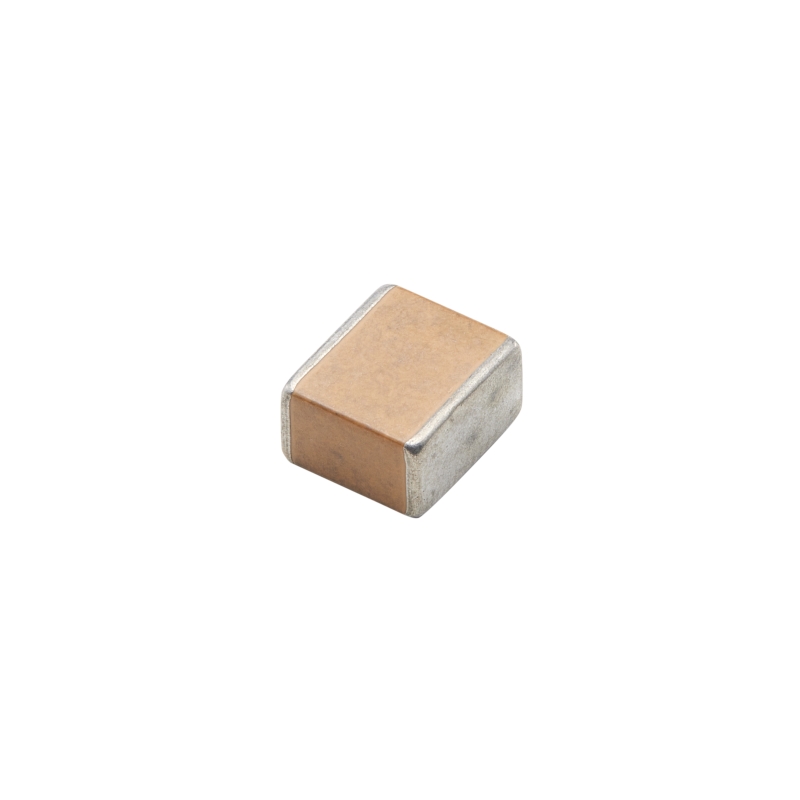
Multi layer ceramic capacitors (MLCC) are made of ceramic medium and metal inner electrode which are superposed in a staggered way. After one-time high-temperature sintering, the ceramic chip is formed, and then the outer electrode metal layer is sealed at both ends of the chip. The dielectric material system of this kind of ceramic capacitor is mainly divided into two types: I ceramic dielectric and II ceramic dielectric.
I ceramic dielectric belongs to paraelectric medium (the main materials are SrZrO3, MgTiO3, etc.), and I ceramic dielectric will not produce electrostrictive deformation. Therefore, MLCC made of I ceramic dielectric material, such as ceramic capacitor with CG characteristics, will not produce acoustic noise when working, but the dielectric constant of this kind of medium is very small, usually between 10 ~ 100, so it is unable to produce large capacitance capacitor.
Type Ⅱ media belong to ferroelectric media (the main material is BaTiO3, BaSrTiO3, etc.), and ferroelectric materials will produce electrostrictive deformation. MLCCs made of type II dielectrics, such as X7R, X5R, etc., usually have a dielectric constant between 2000 and 4000, and the capacitance of the capacitor is relatively large, and it is easy to produce obvious howling noise under the action of a specific AC signal.
Why does MLCC have acoustic noise?
In order to better understand the nature of capacitor noise, let's first understand a natural phenomenon-the piezoelectric effect.
In 1880, brothers Pierre Curie and Jacques Curie discovered that tourmaline has piezoelectric effect. In 1984, the German physicist Wodemar Voith deduced that only crystals with 20 point groups without a symmetry center could have the piezoelectric effect. The piezoelectric effect is due to the special arrangement of atoms in the crystal lattice of the piezoelectric material, which makes the material have the effect of coupling the stress field and the electric field.
The academic definition of the piezoelectric effect is: when certain dielectrics are deformed by external forces in a certain direction, polarization will occur inside them, and at the same time, positive and negative charges will appear on its two opposite surfaces. When the external force is removed, it will return to an uncharged state. This phenomenon is called the positive piezoelectric effect. On the contrary, when an electric field is applied to the polarization direction of the dielectric, these dielectrics will also deform. After the electric field is removed, the deformation of the dielectric disappears. This phenomenon is called the inverse piezoelectric effect, or electrostriction.
Obviously, the ceramic capacitor noise we are discussing is a direct result of the MLCC piezoelectric effect (specifically, the inverse piezoelectric effect). Under the action of an external electric field, the ferroelectric ceramic medium with piezoelectric effect will undergo expansion and contraction. For other types of capacitors, because the dielectric material does not have a piezoelectric effect, the howling on the circuit is basically due to the vibration generated by the inverse piezoelectric effect of the ferroelectric ceramic medium MLCC.
(Picture source network)
As shown in the figure above, the ferroelectric ceramic medium's ferroelectricity will produce piezoelectric effect noise. After an AC signal is applied, multilayer ceramic capacitors will stretch and deform. When the ceramic capacitor is soldered on the circuit board, the capacitor and the circuit board are rigidly connected, and the deformation of the capacitor will pull the circuit board. The circuit board becomes an acoustic impedance transformer. When the vibration frequency reaches the distinguishable frequency band (20Hz~20kHz) of the human ear, then, you will hear acoustic noise.
On what occasions does MLCC have acoustic noise?
When selecting an MLCC capacitor for audio applications, engineers must be particularly careful. In common audio circuits, especially for audiophiles, people usually prefer to use ruby, black diamond, and other electrolytic capacitors. Because the working frequency of the audio circuit is usually relatively low (e.g., several kHz), a ferroelectric ceramic capacitor may produce a whistling sound that can be heard by the human ear. Therefore, these capacitors should be used with caution in audio circuits and high gain circuits.
Under the action of specific AC signals, MLCCs using ferroelectric ceramic dielectrics (such as X7R/X5R) may produce howling. The violent howling comes from violent vibration, and the amplitude is determined by the degree of the MLCC piezoelectric effect.
What is the impact of MLCC acoustic noise?
Due to the existence of capacitive howling, when mobile electronic devices are close to human ears, the audible sound produced by electronic products (laptops, tablets, smartphones) will negatively affect the user's experience. Violent howling will make people feel irritable.
Under an alternating electric field, the ferroelectric domains will alternately turn, increasing the probability of capacitor failure. In addition, the appearance of capacitor noise also indicates that the voltage ripple on the capacitor is too large, which may cause the circuit to work abnormally.
How to Solve It: MLCC Acoustic Noise Reduction Strategies
Achieving effective MLCC acoustic noise reduction is a common challenge for hardware designers. There are several ways to mitigate the howling noise generated by MLCC capacitors, though some solutions may increase costs.
1. Changing the type of capacitor dielectric material is the most direct method. Use Class I ceramic capacitors or film capacitors that do not have a piezoelectric effect. However, volumetric space and cost need to be considered.
2. Adjust the circuit to eliminate the alternating voltage applied to the MLCC as much as possible.
3. Adjust the specifications and layout of the PCB circuit board to reduce vibration.
4. Adjust the size of the MLCC.
5. Use MLCCs specifically designed with low noise characteristics.
Based on this, for the MLCC product itself, we can adopt the following MLCC acoustic noise reduction solutions:
(1) Thicken the protective layer. Since the thickness of the bottom protective layer has no internal electrodes, this part will not be deformed, reducing the impact on the PCB.
(2) Additional metal support structure. It uses a metal bracket to isolate the MLCC chip from the PCB board, elastically buffering the inverse piezoelectric effect.
(3) Adopt lead product structure. The principle is similar to that of the metal bracket.
(4) Design and manufacture using dielectric materials with weak piezoelectric effect by further doping barium titanate (BaTiO3).
(5) Substrate embedded design. A new structure with capacitors mounted on the interposer circuit board is adopted to suppress howling.
Conclusion
Based on the MLCC acoustic noise phenomenon, we analyzed the howling mechanism of ferroelectric ceramic dielectric capacitors (the MLCC piezoelectric effect), and finally enumerated effective strategies for MLCC acoustic noise reduction. In different application scenarios, engineers must weigh the cost and actual effects to choose the best solution and develop quieter, more reliable products.
Read More



 IPv6 network supported