
Multilayer ceramic capacitors (MLCCs) are core passive components widely used in electronic circuits for filtering, voltage stabilization, energy storage, and decoupling. They are often referred to as the “industrial rice” of the electronics industry because of their broad and essential use.
Since the second half of 2025, major passive components including MLCCs, resistors, and inductors have entered a new round of price adjustments, with increases generally ranging from 5% to 30%.
In 2026, this trend expanded further. According to publicly available market information, Samsung Electro-Mechanics raised shipment prices across certain product lines by around 30%; Murata Manufacturing saw cumulative increases of approximately 15% to 40% on selected products; Yageo raised official quotations by around 50%; and other major manufacturers such as Taiyo Yuden also followed with price adjustments.
In addition to price changes, lead times for some high-end, high-capacitance MLCCs have also extended significantly. What was previously a typical lead time of around eight weeks has, for some specifications, stretched to 20 weeks or even more than half a year.
Rising prices, longer lead times, and tighter high-end capacity all point to a more structural shift in MLCC supply and demand.
One of the key factors behind this change is the rapid expansion of AI infrastructure and computing demand.
Compared with conventional general-purpose servers, AI servers and high-density computing racks operate at much higher power and computing densities, while also facing greater transient current fluctuations and electromagnetic interference.
GPUs, high-bandwidth memory (HBM), and high-speed communication chips need to operate continuously under low-voltage, high-current conditions. This requires a large number of high-performance MLCCs with characteristics such as high capacitance, high-temperature capability, and low equivalent series resistance (ESR) to be placed close to the chips.
In other words, rising computing density is increasing not only the number of MLCCs required, but also the performance requirements placed on them.
A conventional general-purpose server typically uses around 2,200 to 4,000 MLCCs, while an AI server may use more than three times that number.
At the rack level, the increase is even more significant.
For example, NVIDIA’s GB300 NVL72 rack is estimated to use around 440,000 MLCCs, significantly increasing the MLCC value per rack.
Future Rubin NVL72 platforms are expected to require even more, with MLCC usage potentially reaching around 570,000 units per rack and the corresponding MLCC value increasing by approximately 166%.
A similar trend can be seen at the accelerator board level.
For AMD’s MI450 platform, the number of certain MLCC specifications used on a single board reportedly increased from around 1,440 units in the previous generation to 10,544 units, representing an increase of approximately 632%.
These figures show that as AI computing platforms continue to move toward higher computing density, MLCCs are becoming one of the passive component categories seeing particularly strong demand growth.
The impact of AI servers is not limited to higher MLCC unit counts.
As GPU and computing-chip power consumption continues to increase, systems must handle more severe transient load changes, which is driving stronger demand for high-capacitance MLCCs.
In particular, more high-capacitance, low-ESR MLCCs need to be placed close to chips and power nodes to improve power stability and transient response.
At the specification level, demand for MLCCs rated at 47μF and above in cloud AI applications is expected to rise from around 4 billion units in 2025 to more than 40 billion units in 2027.
This means future AI-related MLCC demand will continue to move toward:
High capacitance | Smaller size | Higher temperature capability | Lower ESR | Higher performance
As investment in AI servers, data centers, and high-performance computing infrastructure continues, the global MLCC market is expected to enter a new stage of growth.
Industry forecasts suggest that global MLCC shipment value could increase from approximately USD 14.67 billion in 2025 to around USD 44.45 billion by 2031, representing a compound annual growth rate (CAGR) of approximately 20.3%.
At the same time, the high-end AI MLCC market remains highly concentrated.
According to relevant market data, Murata Manufacturing and Samsung Electro-Mechanics together account for around 85% of the global high-end AI MLCC market.
As AI server orders continue to grow, leading overseas manufacturers may prioritize more production capacity for higher-margin, higher-value AI-related products.
This shift in capacity allocation could also affect other application markets.
As more manufacturing resources move toward high-end AI MLCCs, some general-purpose and mid-to-high-end products used in consumer electronics, industrial control, and other sectors may face a certain degree of capacity crowding-out.
Therefore, the current price increases and lead-time extensions in the passive component market reflect more than simple short-term fluctuations. They also involve the reallocation of production capacity toward high-end products, changes in product mix, and shifts in the global supply structure.
For domestic component manufacturers, these structural changes may also create new market opportunities, including the ability to absorb part of the overflow demand and accelerate the localization of higher-end products.
As demand for MLCCs and other electronic components continues to grow and product requirements continue to evolve, Torch Electron is also accelerating production-line development and capacity expansion to further strengthen its manufacturing and supply capabilities.
Since 1989, Torch Electron has remained focused on the electronic component industry and has continued to expand its product portfolio while strengthening production capability in preparation for future market growth.
Beyond MLCCs, Torch Electron and its related businesses have developed a product portfolio covering multiple categories of electronic components.
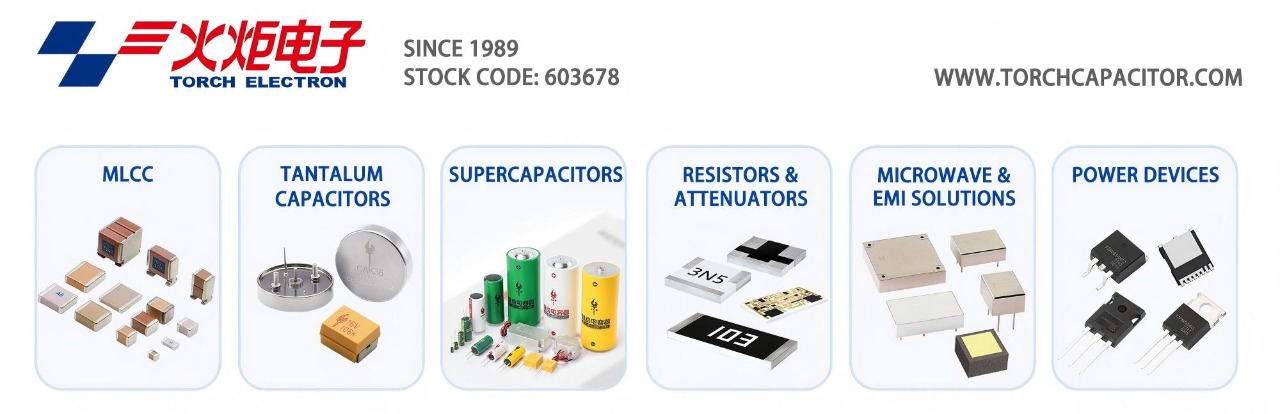
Our main product categories currently include:
MLCC is one of Torch Electron’s core product categories. We provide ceramic capacitor products for different voltage, capacitance, size, and application requirements.
Torch Electron offers a range of tantalum capacitor products to support different voltage, capacitance, and structural requirements.
Our supercapacitor portfolio mainly includes supercapacitor cells and supercapacitor modules, which can be used in energy storage, rapid charge and discharge, power compensation, and other related applications.
Torch Electron also offers chip resistors and temperature compensated attenuators for resistance control, signal attenuation, and temperature compensation in different electronic systems.
In high-frequency and electromagnetic compatibility applications, Torch Electron provides microwave and EMI-related products and solutions for communications, high-frequency electronics, power systems, and other applications.
Our product portfolio also includes power devices, further extending our offering from passive components to power electronics.
The development of AI infrastructure is driving MLCC demand from simple volume growth toward simultaneous growth in quantity, specifications, and performance requirements.
At the same time, industrial control, power electronics, new energy, communications, transportation, and other electronic applications continue to drive demand for tantalum capacitors, supercapacitors, resistors, temperature compensated attenuators, microwave and EMI products, and power devices.
In response to these market changes, Torch Electron will continue to accelerate production-line development and capacity expansion while further strengthening its product portfolio and manufacturing capabilities to support the evolving needs of the global electronics industry.


 IPv6 network supported